Why home distilling is illegal in the US
The short answer: taxes, not safety. Federal tax on spirits is owed the moment the spirit exists. To make sure it gets collected, federal law keeps distilling on registered, bonded premises that tax officers can enter at any hour, and since 1868 it has banned distilleries in homes outright.[1,2,3]
This page describes federal law. It is not legal advice, and it does not explain how to distill. State and local laws add their own rules.
The two lines of law behind the ban
The location rule is in the Internal Revenue Code, 26 U.S.C. § 5178(a)(1)(B):
"No distilled spirits plant for the production of distilled spirits shall be located in any dwelling house, in any shed, yard, or inclosure connected with any dwelling house, or on board any vessel or boat, or on premises where beer or wine is made or produced, or liquors of any description are retailed, or on premises where any other business is carried on (except when authorized under subsection (b))."[3]
The penalty is in § 5601(a)(6). Anyone who uses, or possesses with intent to use, a still, boiler or other utensil to produce distilled spirits in one of those places faces a fine of up to $10,000, up to five years in prison, or both, for each offense. That makes it a felony.[4,5]
The bureau that enforces the law, the Alcohol and Tobacco Tax and Trade Bureau (TTB), repeats the point in its regulations: "A person may not produce distilled spirits at home for personal use."[6] Its public Home Distilling page says federal law "strictly prohibits" it.[7]
How the spirits tax works
- The rate. Most spirits are taxed at $13.50 per proof gallon (a gallon at 100 proof), with lower rates on a producer's first 100,000 proof gallons each year ($2.70) and the next tier ($13.34).[1]
- When it is owed. The tax attaches "as soon as this substance is in existence as such," not when the bottle is sold.[1]
- Where spirits may be made. Distilling may be done only on the bonded premises of a registered distilled spirits plant, after the plant is registered and a permit is issued. Large producers must also post a bond. Every still must be registered as soon as it is set up.[9,10]
- Access for tax officers. A plant must give officers keys, and officers may enter "at all times, as well by night as by day."[2] A plant must even post a sign outside showing the business.[10]
A home cannot meet those rules, because § 5178 rules out a home as a location. In practice the TTB will not consider a distilling permit at a home address.[11]
Why beer and wine are treated differently
Congress wrote exceptions for beer and wine and never wrote one for spirits. Any adult may make beer, and wine, for personal or family use and not for sale, tax-free, up to 100 gallons a year, or 200 gallons for a household with two or more adults.[12,13] The beer exception, and the version of the wine exception that covers every adult, date from a 1978 law, Public Law 95-458.[14]
The TTB's own FAQ draws the line: there is no personal-use exemption for spirits. Spirits made for drinking must be made at a qualified plant and taxed.[15] The details for brewers and winemakers are on making beer and wine at home.
What is legal
- Owning a still for other purposes. The TTB says owning a small still and using it for other things is allowed. Using a still to distill water, or to extract essential oils by steam or water distillation, falls outside its rules, and small stills of a gallon or less used for laboratory work are exempt.[15]
- Still sales are watched. The TTB can require still manufacturers to report the name and address of each customer.[15] The lead plaintiff in the Texas case received a TTB letter after the bureau learned he had bought a still.[5]
- Fuel alcohol. Federal law allows a permit for an alcohol fuel plant, which produces spirits for fuel use only.[15]
A legal kind of distilling. Countertop water distillers, sold as kitchen appliances for making distilled water (for CPAP machines, humidifiers or drinking), are an everyday, legal use of distillation. They are built for water, and using any still to make spirits without a federal permit remains a felony outside the protection of the court order described on this site.
As an Amazon Associate I earn from qualifying purchases.
Was the ban ever about safety?
Not according to the record that created it. The reports Congress relied on in 1866 to 1868 were about lost revenue: the Treasury Secretary described small stills "secreted in the garrets and cellars of the most populous cities," and a House committee estimated that at least seven-eighths of all spirits made had escaped the tax.[5]
The government's defense in court has been about taxes too. The question it asked the Supreme Court to decide is whether the location ban is "necessary and proper for carrying into execution Congress's enumerated power to lay and collect taxes."[5] On appeal it did not defend the ban under the Commerce Clause.[5] General health and safety rules, the "police power," belong mainly to the states; the Fifth Circuit warned against reading the taxing power so broadly that it became a federal police power.[16]
The judges who upheld the ban, in the Sixth Circuit, also reasoned from taxes: stills are easier to hide in homes, homes are much harder to search at any hour than bonded premises, and a ban moves drinkers toward taxed spirits.[10]
The real risks, honestly
None of that means distilling is risk-free. These are the hazards health agencies document.
Methanol
Methanol in drinks can cause blindness, nerve damage or death even at fairly low doses. The Pan American Health Organization ties recent mass poisonings to adulterated drinks, including "substitute alcohols" cut with windscreen wash, antifreeze or fuel alcohol. It also warns about "unrecorded" alcohol in general, a category that includes informal and homemade drinks as well as illicit imports, because it is less regulated and may contain methanol or heavy metals.[17] Fermentation itself releases some methanol from the pectin in fruit, which is why fruit spirits carry more than grain spirits and why the EU sets legal limits for them.[18]
Lead and other contaminants
Improvised equipment is a documented danger. CDC investigators in Alabama linked lead poisoning to moonshine made with car radiators that had lead-soldered parts; seized samples held thousands of micrograms of lead per liter, and nine patients were found.[19] A 2003 study at Atlanta's Grady hospital found that 8.6 percent of 581 patients surveyed had drunk moonshine within five years, and that moonshine drinking was strongly linked to raised blood lead.[20]
Fire
Ethanol has a flash point of about 55 °F and its vapor burns in air at concentrations from 3.3 to 19 percent.[21] Hot equipment releasing alcohol vapor near a flame or spark is a real fire risk. The House bill to legalize home distilling would let stills be sold for home use only if they have a pressure-release valve and a vacuum-relief valve and hold no more than 50 gallons.[22]
These are reasons for safety rules. They are not the reason the federal ban exists, and the ban itself is written as a tax provision.[3,7]
Myths and facts
It's illegal because homemade liquor makes people go blind.
The law was written in 1868 to collect a tax, and the government defends it in court as a tax measure.[5]
It's fine as long as you only make it for yourself.
Beer and wine have a personal-use exemption; spirits do not.[15,12]
Owning a still is illegal.
Owning one for water or essential oils is allowed. The felony is using, or possessing with intent to use, a still to make spirits in a home or another banned place.[15,4]
The Fifth Circuit made home distilling legal.
It upheld an order that stops enforcement of the location ban against the plaintiffs and Hobby Distillers Association members. Its precedent covers Texas, Louisiana and Mississippi. The tax and the rest of the permit system still stand, and the Supreme Court will now decide the question.[5,23,24]
Next: where the law is heading.
Sources
- 26 U.S.C. § 5001: Imposition, rate, and attachment of tax Legal Information Institute, Cornell Law School
- 26 U.S.C. § 5203: Entry and examination of premises Legal Information Institute, Cornell Law School
- 26 U.S.C. § 5178: Premises of distilled spirits plants Legal Information Institute, Cornell Law School
- 26 U.S.C. § 5601: Criminal penalties Legal Information Institute, Cornell Law School
- Petition for a writ of certiorari, DOJ v. McNutt (appendix includes the Fifth Circuit and district court opinions) Office of the Solicitor General, August 14, 2026
- 27 CFR § 19.51: Home production of distilled spirits prohibited Legal Information Institute, Cornell Law School (e-CFR)
- Home Distilling Alcohol and Tobacco Tax and Trade Bureau (TTB), page last updated March 17, 2025
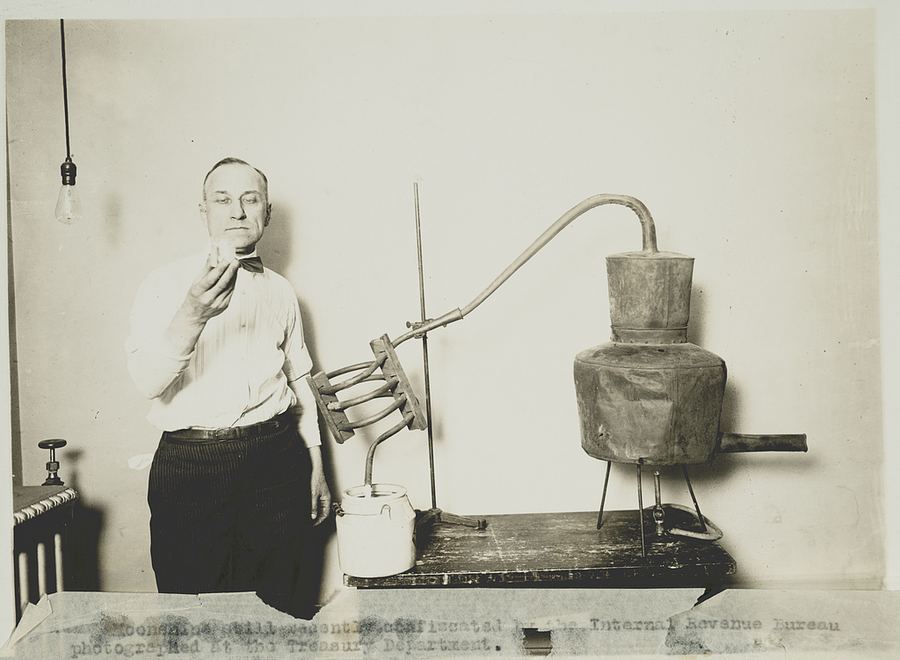
- Moonshine still recently confiscated by the Internal Revenue Bureau photographed at the Treasury Department Library of Congress, National Photo Company Collection (no known restrictions on publication)
- 26 U.S.C. § 5171: Establishment (registration and permits for distilled spirits plants) Legal Information Institute, Cornell Law School
- Ream v. U.S. Department of the Treasury, No. 25-3259 (opinion) U.S. Court of Appeals for the Sixth Circuit, April 21, 2026
- Home distilling in the United States: legal background and the current court fight over the federal ban Husch Blackwell, August 19, 2026
- 26 U.S.C. § 5053(e): Beer for personal or family use Legal Information Institute, Cornell Law School
- 26 U.S.C. § 5042(a)(2): Wine for personal or family use Legal Information Institute, Cornell Law School
- Public Law 95-458, 92 Stat. 1255 (home beer and wine exemptions) U.S. Government Publishing Office, approved October 14, 1978
- Distilled Spirits FAQs (S3, S4, S6, S7) Alcohol and Tobacco Tax and Trade Bureau (TTB)
- McNutt v. U.S. Department of Justice, No. 24-10760 (opinion) U.S. Court of Appeals for the Fifth Circuit, April 10, 2026
- Epidemiological Alert: Risk of methanol poisoning Pan American Health Organization / World Health Organization, October 7, 2025
- Methanol Mitigation during Manufacturing of Fruit Spirits with Special Consideration of Novel Coffee Cherry Spirits Blumenthal et al., Molecules (open access, PubMed Central), 2021
- Elevated Blood Lead Levels Associated with Illicitly Distilled Alcohol: Alabama, 1990-1991 CDC, Morbidity and Mortality Weekly Report
- Morgan finds moonshine drinkers at Grady (on a study in Annals of Emergency Medicine) Emory Report, Emory University, September 22, 2003
- NIOSH Pocket Guide to Chemical Hazards: Ethyl alcohol CDC / National Institute for Occupational Safety and Health
- H.R. 10157, Freedom to Home Distill Act (introduced text) U.S. Government Publishing Office, August 27, 2026
- Fifth and Sixth Circuits Divided on Whether the Necessary and Proper Clause Authorizes Federal Ban on At-Home Spirit Distilling (LSB11459) Congressional Research Service, updated August 26, 2026
- Docket No. 26-204: Department of Justice v. McNutt Supreme Court of the United States, petition granted October 19, 2026
- LD 631, An Act to Allow a Home Distiller to Distill and Share Homemade Spirituous Liquor (status: Public Law 2025, ch. 313) Maine Legislature
- HB 1624 (2024), relative to allowing the distillation of hobby liquors: final text (Chapter 206, approved July 12, 2024, effective January 1, 2025) New Hampshire General Court bill text, via the NHLA bill tracker